
Usenet Combos
Best Usenet Provider Combinations in 2026
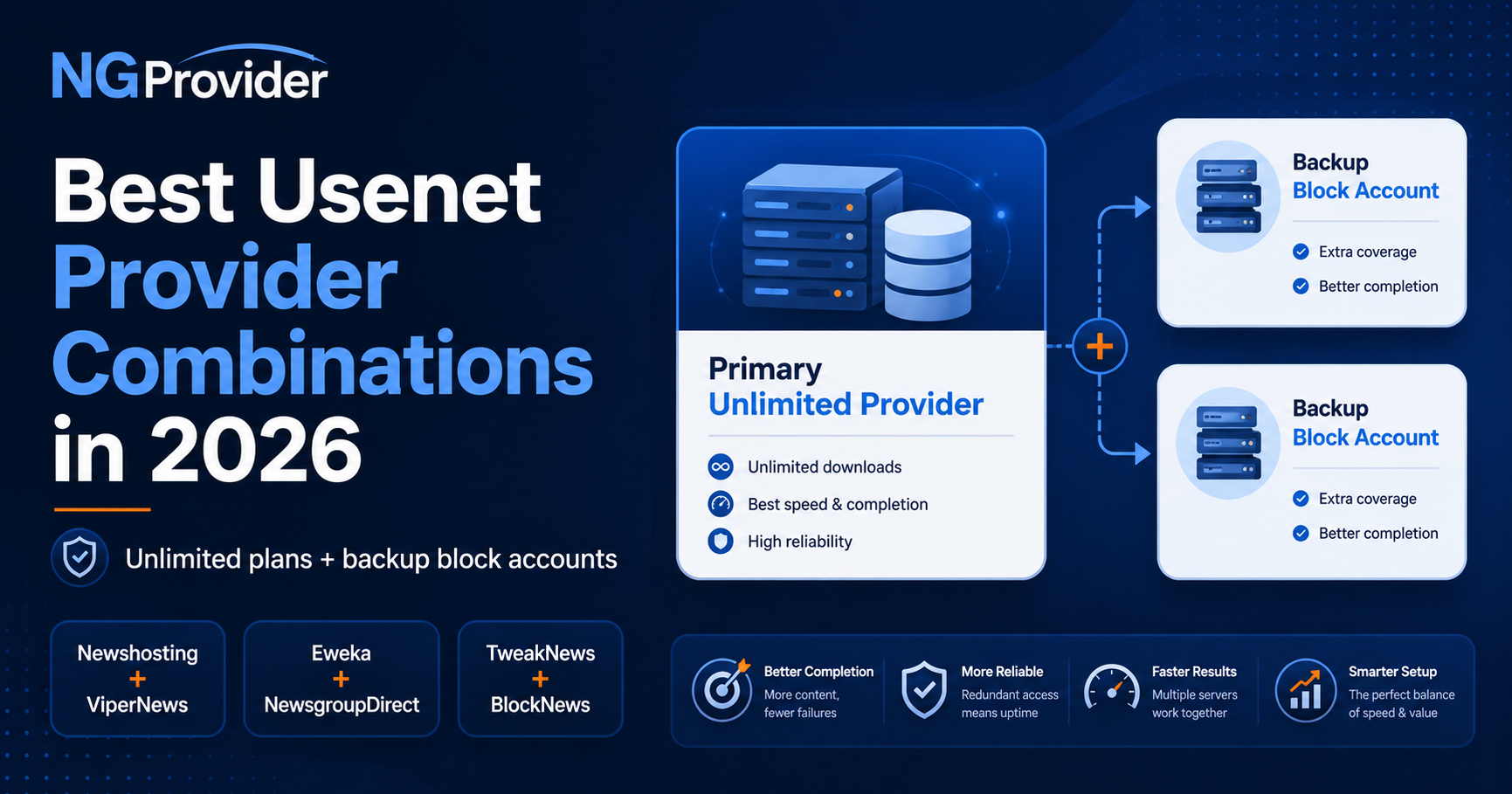
A good Usenet setup is not always about choosing a single provider. For many users, the smartest option is to combine one strong unlimited Usenet account with a backup block account from another provider or backbone. This gives you better completion, more flexibility and stronger reliability without paying for two full unlimited subscriptions.
Why Combine Two Usenet Providers?
Usenet completion depends on several factors: retention, article availability, takedown policies (DMCA - NTD - DSA), server quality, propagation and the backbone used by the provider. Even a very good Usenet provider can occasionally miss some parts of an article.
This is why many experienced Usenetters do not rely on a single source. The best Usenet provider combination is usually not two expensive unlimited plans. Instead, they use one primary unlimited account for everyday access and one secondary account as backup. For most users, the better value is one premium unlimited provider combined with one or more block accounts. If the primary server cannot complete an article, the newsreader can automatically try the backup server.
A block account is prepaid Usenet data. It is consumed only when your newsreader uses it. If your primary unlimited provider completes most articles, the block account may last for months or even years. This makes it an efficient backup solution.
Recommended Unlimited + Block Account Combinations
The table below suggests practical combinations of primary unlimited Usenet providers and secondary block providers. The goal is to avoid duplicating the same access and to add a useful backup source for better completion. When choosing a backup provider, the most important idea is diversity. A backup account is less useful if it gives you the exact same result as your primary provider. You want another source that may still have the article when your main server does not.
| Main Unlimited Provider | Recommended Backup Block Providers * | Why This Combination Works |
|---|---|---|
|
Newshosting
Best Usenet Combo for Most Users |
NewsgroupDirect, BlockNews | Newshosting is a strong primary unlimited account. Newshosting already offers an extremely high completion rate. NewsgroupDirect and BlockNews have the advantage of using two independent backbones, which can help fill in any occasional gaps. |
|
Eweka
Best European Combo |
NewsgroupDirect, BlockNews | Eweka already offers excellent retention and completion (NTD policy), but a secondary block account can add extra provider diversity. |
| UsenetServer | NewsgroupDirect, BlockNews | UsenetServer is one of the biggest Usenet providers. UsenetServer has very strong completion thanks to its excellent peering and the quality of its servers. A block account can still help complete an occasional missing file. |
| TweakNews | NewsgroupDirect, BlockNews | TweakNews works well as a European primary account. Adding Blocknews or NewsgroupDirect gives extra backup options. |
| UsenetExpress | TweakNews, BlockNews | UsenetExpress is a good US-based backbone. A block account can provide a useful second source. |
| NewsgroupDirect | TweakNews, BlockNews | NewsgroupDirect is already interesting because of its multi-backbone approach, but an external block account can still improve redundancy. |
| FastUsenet | TweakNews, BlockNews | FastUsenet already benefits from the excellent completion of the backbone it resells. However, a block account can still help complete occasional incomplete files during downloads. |
| UsenetNow | TweakNews, BlockNews, Newsgroupdirect | UsenetNow uses a small independent backbone. Its lower retention means that high-retention block accounts can be useful if you want to download files that were posted a long time ago. |
* A block account is prepaid Usenet data. It is consumed only when your newsreader uses it. If your primary unlimited provider completes most articles, the block account may last for months or even years.
The smartest Usenet provider combination in 2026 is usually one strong unlimited account plus one backup block account from a different provider or network. It is simple, cost-effective and often more useful than paying for two unlimited subscriptions.
Usenet Provider Combinations FAQ
What is the best Usenet provider combination?
The best Usenet provider combination is usually one strong unlimited Usenet account used as the primary server, combined with one or more backup block accounts from different providers or networks.
This setup improves completion and reliability without requiring two full unlimited subscriptions.
Why combine an unlimited Usenet plan with a block account?
An unlimited Usenet plan is ideal for regular use, while a block account is useful as backup access.
If the main server cannot complete an article, the newsreader can try the backup block account. This can improve completion while keeping costs under control.
Should I use two unlimited Usenet providers?
Most users do not need two unlimited Usenet subscriptions. A better value setup is often one premium unlimited provider combined with a smaller block account from another provider or network.
Heavy users may still prefer two unlimited accounts, but this is usually more expensive.
Which providers are good as primary unlimited Usenet accounts?
Popular primary unlimited Usenet options include Newshosting, Eweka, TweakNews, UsenetExpress, NewsgroupDirect and ViperNews.
The best choice depends on your location, preferred provider, retention needs, speed expectations and budget.
Which providers are useful as backup block accounts?
Useful backup block account providers include ViperNews, NewsgroupDirect, BlockNews, TweakNews and Usenet.Farm.
The most important point is to choose a backup that complements your main provider instead of duplicating the exact same access.
Does using several Usenet providers improve completion?
Using several Usenet providers can improve completion because your newsreader can search more than one source when an article is incomplete or unavailable on the main server.
The improvement depends on the providers, their retention, their takedown policies and their network arrangements.