Usenet Backbones
Best Usenet Backbones: How Provider Networks Really Work
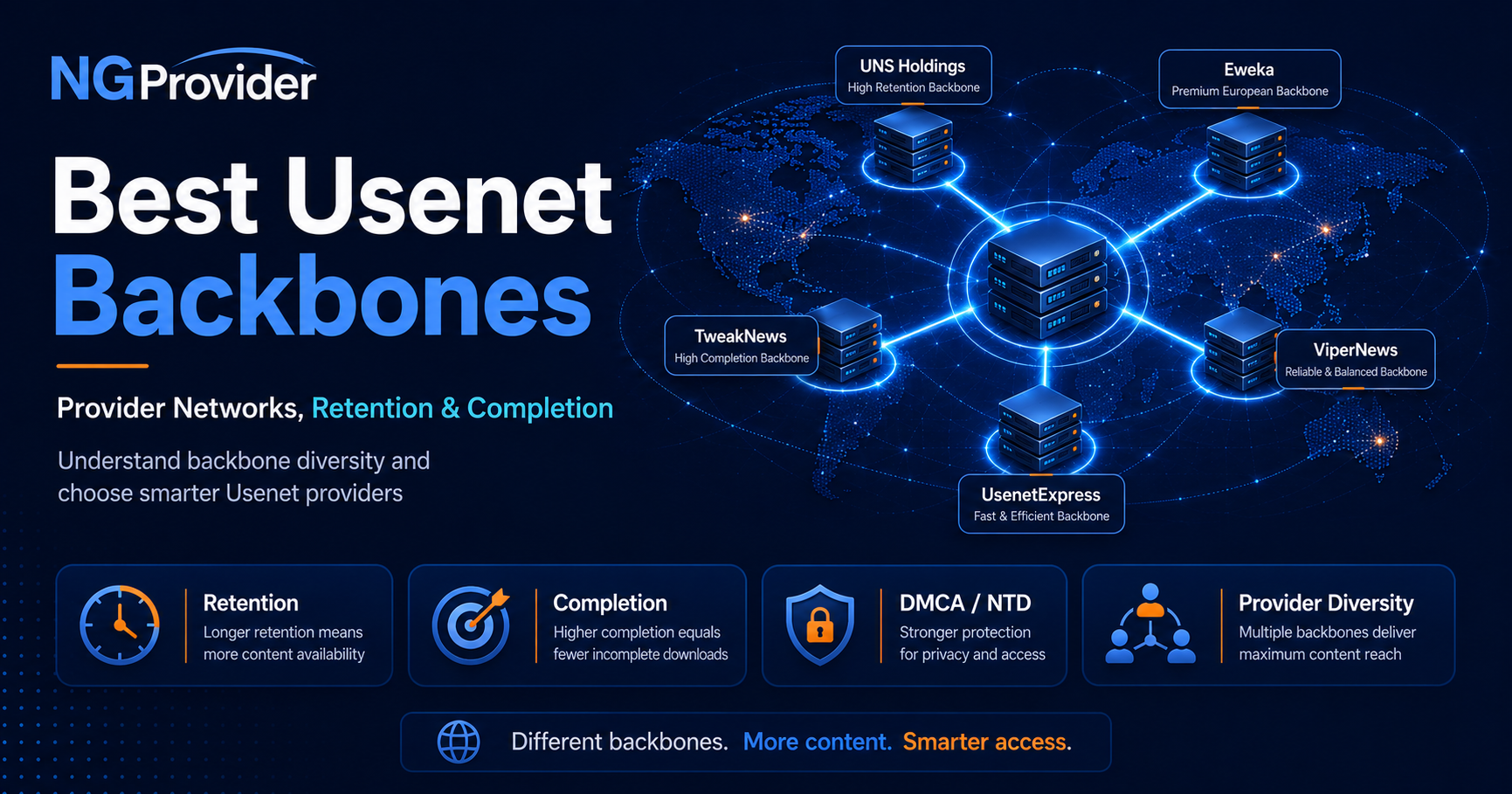
A Usenet provider is the brand you subscribe to. A Usenet backbone is the network that actually powers the service. USENET backone is an important point to understand. A Backbone is the main provider of Usenet servers: Tier-1 Provider and Usenet reseller. It influences retention, completion, speed, takedown handling and whether two providers are truly independent from each other.
This guide helps you look beyond provider names, avoid duplicate networks and build a more reliable Usenet setup based on real backbone diversity.
Quick Navigation
What Is a Usenet Backbone?
A Usenet backbone is the server network that stores, exchanges and serves Usenet articles. When you subscribe to a Usenet provider, you may be buying direct access to that provider's own infrastructure, or you may be buying access through a reseller that uses another upstream network.
In commercial terms, the major backbone operators are often the equivalent of Tier 1 Usenet providers. They operate the core infrastructure, maintain the article storage, handle peering and provide wholesale access to other brands or resellers. Smaller providers may then sell Usenet access under their own name while relying partly or entirely on one of these larger backbone networks.
This is why the backbone is often more important than the brand name. It can influence article retention, completion, speed, peering quality, takedown handling and whether your backup provider is genuinely different from your main provider.
Why Usenet Backbones Matter
Most users compare Usenet providers by price and retention. Those criteria are useful, but they do not tell the whole story. The backbone behind the provider often explains why one service completes a download while another one fails.
A backbone is also about where and how you connect to Usenet. Some providers operate several binary endpoints or server locations, such as US and European NNTP servers. The physical location of the Usenet server has some incidence on speed. For better speed, you should seek a server that is geographically close to you.
Backbones can affect:
- Retention: how far back the provider can serve articles.
- Completion: whether all parts of a post are still available.
- Speed: network quality, routing, peering and server capacity.
- Bandwidth and routing priority: available network capacity and access to priority routes can help maintain fast, consistent download speeds, including during peak periods.
- Binary endpoints: the NNTP server locations you connect to for binary downloads.
- Takedown policy: DMCA or European Notice and Takedown processes.
- Provider diversity: whether two subscriptions really complement each other.
If you only use one Usenet provider, the backbone helps you understand what type of infrastructure you are trusting. If you use multiple providers or add a block account, backbone knowledge becomes even more important because you want real network diversity, not just another brand name.
Best Usenet Backbones Compared
The table below compares the main Usenet backbone families from a practical user perspective. The goal is not only to list brands, but to show which networks are Tier 1 providers, which services are resellers, where binary endpoints are typically located, and how each backbone can fit into a reliable Usenet setup.
You do not need a complicated setup to use Usenet well. Most users should start with one strong primary provider. Newshosting and Eweka remain the easiest starting points for mainstream users.
| Backbone | Typical Policy 1 | Tier 1 Providers | Resellers | Binary Endpoints | Retention Max 2 | Best For |
|---|---|---|---|---|---|---|
| UNS Holdings | DMCA | Newshosting, UsenetServer, Easynews | FastUsenet, Astraweb, NewsgroupNinja | US endpoints in Los Angeles and Ashburn, plus European NNTP access in Amsterdam, depending on the provider |
6,500+ days Full Retention |
Best overall backbone family for mainstream Usenet access, high retention, strong completion and reliable speed. |
| Eweka | NTD | Eweka | Netherlands-based European NNTP access in Amsterdam |
6,500+ days Full Retention |
Best European-focused backbone for completion, long retention and users who prefer EU-based access. | |
| UsenetExpress | DMCA | UsenetExpress | NewsgroupDirect, NewsDemon | US endpoints in Los Angeles and Ashburn, plus European NNTP access in Amsterdam | 5,000 days Popular Retention | Independent US-based backbone diversity, advanced Usenet setups, different completion behavior and unlimited plus block account combinations. |
| BaseIP | NTD | TweakNews | XLNed, PureUsenet | Netherlands-based European NNTP access in Amsterdam |
5,000+ days Full Retention |
An unlimited European alternative to Eweka, plus block accounts for provider combinations, backbone diversity and testing the BaseIP network. |
| Vipernews | NTD | ViperNews |
Netherlands-based European NNTP access via
news.vipernews.com
|
4,500+ days advertised Selective / Effective Retention |
Independent European Tier 1 backbone, NTD-based provider diversity, unlimited access and non-expiring block accounts for backup, completion and occasional posting. | |
| NetNews | DMCA | BlockNews, UsenetNow | Seven advertised regional NNTP systems: USA endpoints in Los Angeles and Ashburn, plus locations in Europe, Africa, Asia through Tokyo, Australia through Sydney, and South America through São Paulo | 5,000 days Popular Retention | Advanced users who want additional backbone diversity, backup options and a wider choice of regional NNTP endpoints. | |
| Giganews | DMCA | Giganews | Supernews | US NNTP access in Austin and European NNTP access in Amsterdam | Popular Retention | Users who want an independent historic backbone, mainly use automation, and focus on recent or popular posts in the main binary newsgroups. |
|
1. DMCA and NTD policies: backbone location can influence takedown handling. US-based providers (Corporate offices) generally operate under DMCA-style takedown processes, while European providers are more commonly associated with Notice and Takedown policies. Neither framework is automatically better. Providers may process removal requests differently, which can affect article availability and completion for posts subject to takedown requests. Combining providers operating under different policy environments can sometimes improve completion. |
||||||
|
2. Full retention vs popular retention: full retention means that the backbone aims to retain all available binary articles for the advertised period, subject to takedown requests, missing parts and technical limitations. Popular retention is more selective. Recent, frequently accessed or popular articles may remain available, while older or less frequently requested posts can disappear earlier. As a result, a backbone advertising popular retention may perform well for current releases and major newsgroups without offering the same historical coverage as a full-retention provider. The maximum retention figure should therefore not be considered alone. Completion, newsgroup coverage and whether the provider offers full or popular retention are equally important. |
||||||
UNS Holdings Backbone: Best Overall Network
UNS Holdings is the backbone family behind several major Usenet brands, including Newshosting, UsenetServer and Easynews. This makes it one of the most important networks in the Usenet market.
The main strength of this backbone family is scale. It is usually associated with very long retention, high completion, strong peering and reliable mainstream NNTP access. For users who want one provider that simply works well in most situations, this is the backbone family behind many of the strongest choices.
Best UNS Holdings providers
- Newshosting
Newshosting is our #1 overall Usenet provider. It combines direct access to the UNS Holdings backbone with full binary retention, strong completion, fast NNTP connections, an included newsreader and VPN access.
It is the best choice for users who want a complete all-round Usenet package and do not want to assemble several separate tools or services.
Read our complete Newshosting Review.
- Easynews
Easynews provides a very different way to access the UNS Holdings backbone. Its main advantage is its web-based Usenet search interface, which allows users to search, preview and access files directly from a browser.
Traditional NNTP access is also included, making Easynews particularly useful for beginners, mobile users and anyone who wants both browser-based search and standard Usenet access in one account.
Read our complete Easynews Review.
- UsenetServer
UsenetServer is the most straightforward option within the UNS Holdings provider family. It focuses primarily on reliable NNTP access, strong completion and long binary retention without emphasizing a web-based interface.
It is a good value choice for users who already have their preferred newsreader, NZB indexers and automation tools, and mainly want solid access to the backbone.
Read our complete UsenetServer Review.
This backbone family is ideal as a primary provider. However, if you already use Newshosting, adding another provider from the same infrastructure may not bring as much completion diversity as adding a different backbone or a backup block account.
Eweka Backbone: Best European Completion
Eweka is one of the strongest European Usenet options. It is especially interesting for users who want Netherlands-based infrastructure, strong completion and a European Notice and Takedown approach.
Eweka is our favorite European Usenet provider because it combines excellent article retention, unlimited data, SSL-secured connections and reliable NNTP performance. It is also a strong alternative to US-focused providers for users who prefer a European setup.
UsenetExpress Backbone
UsenetExpress is a US-based backbone that is especially interesting for users who want provider diversity beyond the largest mainstream networks. UsenetExpress is relevant because it represents independent provider diversity.
Its main value comes from its independent network, with a different retention profile, completion behavior and technical infrastructure. This makes UsenetExpress a useful option for users who want backbone diversity beyond the largest mainstream Usenet networks.
UsenetExpress is also interesting from a technical perspective because it promotes advanced NNTP features such as NNTP pipelining and post-quantum SSL support. These features reinforce its positioning as a technically focused backbone rather than just another reseller brand.
Users who already have a primary unlimited provider may consider a UsenetExpress-based service or block account to improve coverage, especially through providers such as NewsgroupDirect.
BaseIP Backbone
BaseIP is an independent Usenet backbone based in the Netherlands. Its Tier 1 provider is TweakNews, which gives direct access to the main technical characteristics of the BaseIP network: European NNTP infrastructure, SSL-secured connections, its own retention profile and its own completion behavior.
TweakNews Unlimited: A European Alternative to Eweka
TweakNews is another European Usenet option, but it is not positioned exactly like Eweka. Teaknews is relevant because it represents independent European provider diversity. Its unlimited plans provide access to a different Dutch backbone, making TweakNews a genuine alternative for users who want European Usenet access without using the Eweka network.
Because BaseIP has its own infrastructure, retention profile and completion behavior, TweakNews can produce different results from Eweka or from providers operating on major US-based backbones. This makes it especially relevant for users who want an independent European unlimited provider.
TweakNews Block Accounts: Useful for Backbone Diversity
TweakNews also offers block accounts, which is one of the most useful aspects of the BaseIP ecosystem. Instead of subscribing to another unlimited plan, users can buy a fixed amount of data and configure the account as a backup server in their Usenet downloader.
A TweakNews block account can therefore be used to improve provider diversity, complete occasional missing articles or test the BaseIP backbone before choosing a full unlimited subscription. It is particularly useful when the main provider operates on a different US or European network.
ViperNews Backbone
ViperNews operates its own independent European Tier 1 Usenet platform. Unlike many consumer Usenet brands that rely on a larger upstream provider, ViperNews offers a separate retention, completion and takedown profile, making it particularly interesting for backbone diversity.
Its independent infrastructure can complement providers operating on larger US-based networks. ViperNews also operates under a European Notice and Takedown environment rather than the US DMCA framework, which can result in different article availability and occasionally improve completion when used alongside another backbone.
ViperNews advertises access to messages more than 4,500 days old, although this should not be interpreted as 4,500 days of full binary retention across every newsgroup. Its main strength is therefore independent article availability and provider diversity rather than maximum historical retention.
Access is available through both unlimited plans and non-expiring block accounts. The block accounts are especially useful as secondary access because they can remain configured until needed, while posting support also makes them practical for occasional Usenet posting.
NetNews Backbone
Smaller independent backbones and access networks can be useful for advanced users. NetNews is an independent Usenet backbone based in the United States. Its most distinctive feature is the number of binary endpoints it advertises. With seven regional NNTP systems, NetNews stands out from many other backbones that mainly focus on the United States and Europe.
This wider endpoint footprint can be useful for users who want server locations closer to their region. NetNews advertises binary endpoints in the USA and Europe, with additional NNTP server locations in Africa, Asia, Australia and South America. From a backbone perspective, this makes NetNews especially interesting for advanced users who care about routing, latency and regional access diversity.
Its two main Tier 1-style consumer-facing services are UsenetNow and BlockNews. UsenetNow is the unlimited access option, while BlockNews is focused on prepaid Usenet block accounts. This makes the NetNews backbone relevant both for users looking for a full unlimited account and for users who only want backup access to improve provider diversity.
NetNews also has a serious technical profile. It supports SSL-secured Usenet access, accepts Bitcoin payments through some of its services, and is positioned around a privacy-respecting approach. This does not make it an anonymity solution by itself, but it reinforces its appeal for users who want a more discreet and independent Usenet setup.
The main limitation is retention. NetNews advertises around 5,000 days of retention, which is solid, but lower than the highest-retention mainstream networks that now advertise 6,500+ days. It is also not always clear how complete that retention is across all Newsgroups and all binary endpoints. For that reason, NetNews is best understood as a strong independent backbone for diversity and backup use, rather than simply as the highest retention option on the market.
Giganews Backbone
Giganews is one of the most historic Usenet backbones and remains an independent network. For many years, it was considered one of the premium names in Usenet, with a strong reputation for reliability, infrastructure quality and long-term presence in the market.
However, the technical profile of Giganews is no longer the same as it was during its strongest years. Its main limitation today is retention. Unlike the highest-retention providers that advertise full binary retention across very long time periods, Giganews is better understood as a provider with popular retention: it can still be useful on active and commonly used newsgroups, but it is not the best choice if your priority is retrieving very old posts.
This makes Giganews a more specialized backbone in a modern Usenet setup. It can still make sense for users who mainly rely on automation tools and mostly download recent or popular releases from the main binary newsgroups. In that type of workflow, very deep retention may be less important than stable access, consistent performance and an independent backbone.
Giganews is therefore not the first backbone we would recommend for users who want maximum retention or the highest possible completion on older posts. Its value is different: it remains an independent Usenet backbone with a long history, and it can still be relevant for users who want a separate network focused on current and popular content.
Backbone Diversity: Why Combine Providers?
The main reason to understand backbones is provider diversity. Backbone diversity becomes useful when you want to improve completion or reduce dependence on a single network. If your main provider cannot complete a download, a backup provider on the same backbone may fail for the same reason. A different backbone has a better chance of adding value. This is why many experienced users combine one unlimited provider with a backup block account from a different network. The unlimited provider handles most downloads. The block account is used only when missing parts are needed.
If completion is your goal, choose combinations based on different backbones, not just different brand names. Our provider combination guide explains the best unlimited plus block account setups.
For most users, the best Usenet backbone is the one behind a reliable provider with strong retention, completion and speed. Newshosting remains our best overall provider, Eweka is our favorite European provider, and Easynews is the easiest web-based Usenet option.
Backbone knowledge becomes more important when you want to combine providers. In that case, the goal is simple: avoid paying twice for the same underlying network and choose a backup provider or block account that adds real diversity.