
Usenet Completion: Why Articles Go Missing and How to Improve It
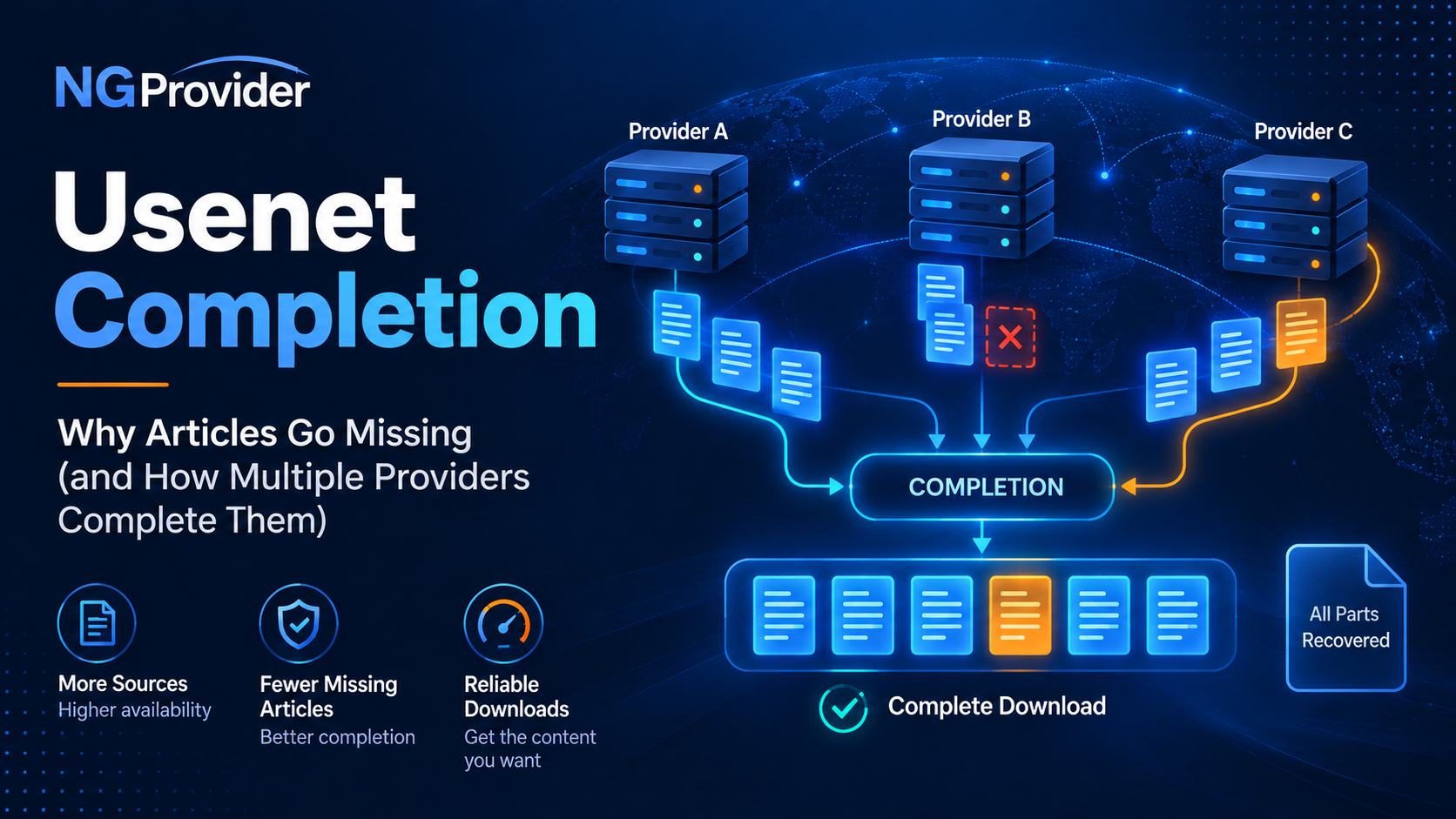
Usenet completion measures how consistently a provider can deliver the articles requested from its servers. For binary posts, good completion is especially important because a single post can consist of many individual article parts. If too many parts are unavailable, the complete post may no longer be recoverable.
High completion depends on much more than one advertised percentage. Article retention, backbone infrastructure, propagation, takedown handling and the age of the post can all affect availability. Two providers can therefore advertise similarly high completion rates while producing different results for the same Usenet articles.
This guide explains what Usenet completion really means, why articles go missing and how different providers, backbones, NZB indexers and backup accounts can be combined to improve real-world article availability.
Quick Navigation
What Is Usenet Completion?
Completion describes how much of the Usenet feed a provider can actually serve when users request articles. In simple terms, a provider with high completion has a very large proportion of the articles that reached Usenet and are still within its storage and retention policies.
Completion becomes especially important with binary posts. A binary post is usually split into many smaller Usenet articles. Your newsreader or downloader requests those parts individually and reconstructs them locally. If some of the required articles are missing, the download may become incomplete unless PAR2 recovery data can repair the missing pieces.
Usenet completion depends on:
- Article propagation: whether all parts successfully reached the provider's servers.
- Retention: whether those articles are still stored when you request them.
- Takedowns: articles may become unavailable following DMCA or NTD requests.
- Backbone infrastructure: different networks can retain different article parts.
- Provider diversity: a second independent backbone may contain parts missing from the first.
- Indexer quality: a different NZB may point to another version of the same material that remains available.
Usenet Providers with Strong Completion
Provider-advertised completion rates are useful for comparison, but they should be read as network-wide performance indicators rather than guarantees for individual posts. Retention, backbone diversity and takedown history still matter.
| Provider | Advertised Completion | Retention Profile | Takedowns | Completion Angle | Review |
|---|---|---|---|---|---|
| Newshosting | 99.99% | 6,600+ days, growing full retention | DMCA | Excellent starting point for users who want long retention and very high advertised completion on a major Tier 1 network. | Newshosting Review |
| Eweka | 99.99% successful downloads advertised | 6,500+ days, growing retention | NTD | Independent European infrastructure and NTD handling make Eweka a strong alternative to US-based networks. | Eweka Review |
| UsenetServer | Over 99% under normal conditions | 6,600 days of complete article retention advertised | DMCA | Strong peering, long retention and reliable mainstream NNTP access. | UsenetServer Review |
| TweakNews | 99.99% | 5,000 days advertised | NTD | Independent European BaseIP backbone and NTD environment provide a useful completion profile for backup or primary access. | TweakNews Review |
| UsenetExpress | 99%+ | Independent retention profile | DMCA | Independent US Tier 1 backbone that can add genuinely different article availability to a multi-provider setup. | UsenetExpress Review |
| NewsgroupDirect | Multi-backbone coverage | 5,800+ days, growing | DMCA | Bundles multiple independent backbones, making it especially interesting when one network is missing segments of a post. | NewsgroupDirect Review |
| ViperNews | Not positioned around a headline completion percentage | 4,500+ day messages advertised | NTD | Independent European Tier 1 platform with NTD handling and non-expiring block accounts for complementary completion. | ViperNews Review |
Usenet Completion vs Retention
Retention and completion are closely related, but they measure different things. Retention tells you how far back a provider can potentially serve articles, while completion describes whether the articles you request are actually available.
For example, a provider may advertise more than 6,000 days of retention, but an individual post inside that retention window can still be incomplete because some article parts were removed, failed to propagate or were never successfully posted in the first place.
| Metric | What It Measures | What It Does Not Guarantee |
|---|---|---|
| Retention | How old an article can potentially be and still remain available. | That every post inside the retention window is complete. |
| Completion | Whether requested articles and binary parts are actually available. | That every specific NZB or post will succeed. |
How DMCA and NTD Policies Affect Completion
Takedown handling can influence article availability. US-based Usenet providers generally operate under DMCA-style processes, while European providers are more commonly associated with Notice and Takedown (NTD) procedures.
Neither framework automatically provides better completion. The practical difference is that requests may be received, reviewed and processed at different times by different providers. As a result, an article removed from one backbone may still be available from another network operating under a different legal and technical environment.
This is one reason why European providers such as Eweka, TweakNews or ViperNews can sometimes complement a US-based primary provider. The benefit comes from a different backbone and takedown environment, not from a guarantee that NTD always retains articles longer than DMCA.
How to Improve Usenet Completion
Best ways to improve real-world completion
- Choose a provider with strong retention and completion: long storage and reliable propagation create a better starting point.
- Add a different backbone: a second independent network may contain missing parts.
- Use a block account: configure it as a backup server so it is only used when the primary provider fails.
- Try another NZB: a different post may still be complete even when the first one is not.
Providers with Full Binary Retention
Newshosting, Eweka and UsenetServer are strong examples of providers using full binary retention. This means their networks aim to retain the complete available binary feed for the advertised retention period, rather than selectively keeping only the most popular or frequently requested articles.
Using a Block Account to Improve Completion
A Usenet block account gives you a fixed amount of data instead of a recurring unlimited subscription. For completion purposes, the best use is as a secondary server on a backbone that differs from your main provider.
Because the block is only used when your primary server cannot supply an article, even a relatively small block can last a long time. This makes block accounts one of the most cost-effective ways to add provider diversity without paying for two unlimited subscriptions.
| Block Option | Main Completion Advantage | Useful For |
|---|---|---|
| TweakNews | Independent European BaseIP access with a different NTD and retention profile. | European backup access and long-retention article recovery. |
| ViperNews | Independent European Tier 1 platform with non-expiring blocks and a different NTD profile. | Backup completion, occasional posting and provider diversity. |
| BlockNews | Independent NetNews-based block access with a different article availability profile. | Occasional missing articles and low-cost backup access. |
| NewsgroupDirect | Multi-backbone access can expose additional article copies across several networks. | Advanced completion setups and older or difficult posts. |
See our full Best Usenet Block Accounts guide for block sizes, prices and backbone combinations.
For better completion: prioritize backbone diversity rather than simply adding another Usenet brand. The main provider handles almost all traffic, while the backup is only used for articles that cannot be retrieved from the first network. For example, a long-retention US-based unlimited provider can be paired with a European NTD block account, or a European primary provider can be complemented by an independent US backbone. The goal is not to collect as many subscriptions as possible, but to maximize the chance that the same article exists somewhere else when your primary server returns a missing-part error. See our Usenet Combo guide.
Do NZB Indexers Improve Completion?
NZB indexers do not change the completion rate of your Usenet provider. An indexer cannot put a missing article back onto a provider's servers, and it cannot repair a backbone that no longer stores part of a post.
What a good indexer can do is improve your download success rate. Different indexers may discover different posts, posting dates, reposts or obfuscated versions. If the first NZB points to an incomplete article set, another NZB may reference a different version that is still fully available. See our NZB Sites and Indexers guide for more information.
Using more than one reliable NZB indexer can therefore be useful, but the benefit is discovery, not provider-side completion. This distinction is important when diagnosing why a download fails.
Usenet Completion FAQ
What is Usenet completion?
Usenet completion describes how consistently a provider can deliver the articles requested from its servers. For binary posts, high completion means that the individual article parts required to reconstruct a post are available.
Is Usenet completion the same as retention?
No. Retention measures how far back articles may remain available, while completion measures whether the requested articles are actually present. A post can be inside a provider's retention window and still be incomplete.
Why are Usenet articles missing?
Articles can be missing because of propagation gaps, incomplete original uploads, retention limits, takedown requests, technical failures or differences between Usenet backbones.
Can a second Usenet provider improve completion?
Yes, especially when the second provider uses a different backbone. An independent network may still have article parts that are unavailable on the primary provider.
Do NZB indexers improve Usenet completion?
NZB indexers do not change the completion rate of a Usenet provider. However, multiple good indexers can improve download success by helping you find alternate posts or different NZBs whose article parts are still available.
Can a block account improve completion?
Yes. A block account on a different backbone can be configured as a backup server and used only when the main provider is missing article parts.
Does NTD always provide better completion than DMCA?
No. DMCA and Notice and Takedown are different legal and operational environments. Neither guarantees better completion, but combining providers operating under different takedown frameworks can sometimes produce different article availability.
Does a 99.99% completion claim guarantee every download will work?
No. Advertised completion percentages describe overall provider performance and do not guarantee that every specific post or every article part will always be available.