
Usenet Storage and Availability
Usenet Retention: How Article Storage and Availability Really Work
Usenet retention measures how long articles remain available on a provider's servers. The number of advertised days is important, but it does not explain whether the provider keeps the full feed, only popular articles, or whether all required article parts remain available.
A provider advertising 6,500 days of retention may potentially offer access to articles posted almost eighteen years ago. However, the headline number does not tell the whole story.
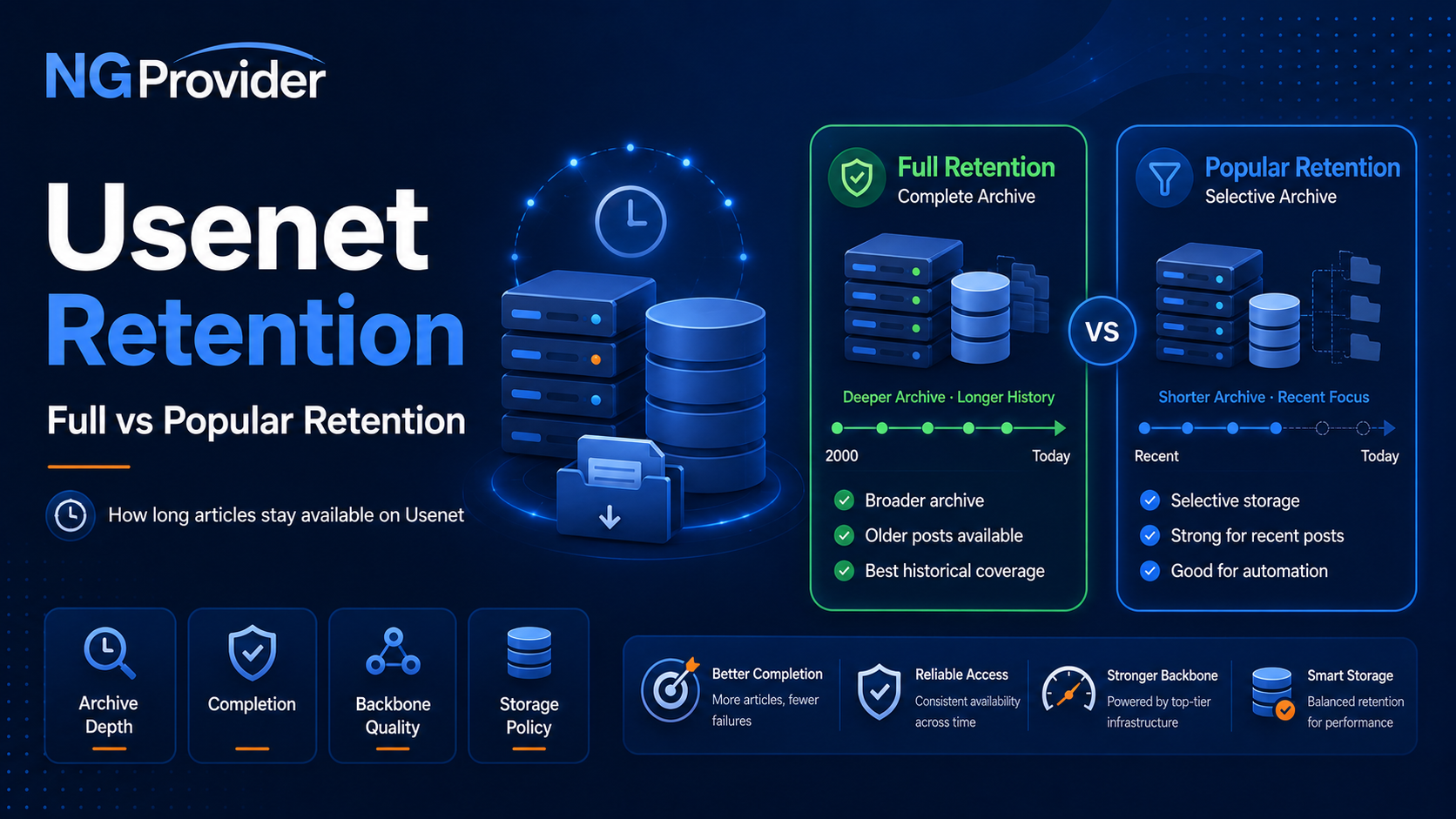
Some Usenet backbones use Full Retention and aim to preserve the complete available feed for the advertised period. Others rely on Popular Retention, where frequently requested posts can remain available longer than less popular articles.
Completion, supported newsgroups, takedown handling, local storage and backbone quality are therefore just as important as the maximum retention figure. This guide explains how to read retention claims and choose a provider based on real article availability rather than one marketing number.
Quick Navigation
What Is Usenet Retention?
Usenet retention is the length of time articles remain accessible through a provider or backbone. Retention is usually expressed in days. If a provider advertises 5,000 days, it means that its archive may contain articles posted approximately 5,000 days ago.
In Usenet terminology, an article is an individual message or one part of a larger binary post. Large files are divided into many article parts. A provider must keep those parts available if the complete post is to remain retrievable.
Retention is not just a number
- Retention days: the maximum age of articles that may remain accessible.
- Full retention: the backbone aims to retain the complete available article feed for the advertised period.
- Popular retention: selected or frequently requested articles may remain available for the maximum period.
- Completion: whether all article parts required for a post are actually available.
- Backbone storage: whether articles are stored on the provider's own infrastructure or retrieved through another network.
Retention usually grows by one day when a provider continues storing the daily Usenet feed without removing the oldest articles solely because of age. Other providers maintain a shorter rolling archive or remove less frequently requested articles to control storage requirements.
Why Usenet Retention Matters
Longer retention expands the historical range of Usenet that you can search and retrieve. It is especially useful when you are looking for older discussions, less recent binary posts, rare material or files that are no longer actively indexed elsewhere.
Low retention can still work well for users who only retrieve recent posts through automation. However, a short archive gives your newsreader or NZB downloader fewer alternative article copies and less historical depth when an indexer points to an older post.
Full Retention vs Popular Retention
The distinction between full and popular retention is one of the most important points when comparing Usenet providers. Two services may display similar retention figures while offering very different historical coverage.
| Retention Type | How It Works | Main Strength | Main Limitation | Best For |
|---|---|---|---|---|
| Full Retention | The backbone aims to retain the complete available article feed for the advertised period, subject to takedown requests, missing parts and technical limitations. | Better historical coverage across both popular and less frequently requested posts. | Requires significantly more storage capacity and infrastructure investment. | Users who want old posts, broad newsgroup coverage and the broadest possible access to the Usenet archive. |
| Popular Retention | Frequently accessed, recent or popular articles are kept longer, while less requested posts may be removed earlier. | Can perform well for recent releases and active major binary newsgroups. | The maximum advertised age may not apply equally to every article or newsgroup. | Automation users focused on recent or popular posts rather than deep historical coverage. |
As a general guideline, it is recommended to select a provider that explicitly states the exact retention period in days. This ensures transparency and clarity regarding the duration for which posts are retained. Additionally, it is advantageous to choose a provider that offers the same retention period for all articles across all newsgroups. This guarantees consistent access to a comprehensive range of posts without limitations or discrepancies.
Usenet Providers with Strong Retention
Several major Tier 1 providers advertise long and growing article retention. The services below share strong historical coverage but offer different access models and included features.
Top Usenet Providers with Full Binary Retention
-
Newshosting
Newshosting offers an industry-best retention rate of 6585+ days for all 110,000 binary and text newsgroups. With complete article availability, you'll have access to an astounding number of USENET posts to explore, surpassing other providers by billions of posts. Moreover, Newshosting's retention rates continue to grow daily, ensuring you never miss a new or old Usenet post.
Read our complete Newshosting Review.
-
Eweka
Eweka offers the best retention of any European Usenet provider. Eweka currently supports up to 6582+ days of binary and text retention in every newsgroup, making it one of the largest archives of Usenet available. Eweka also grows their retention, meaning their storage spool constantly growing, increasing day by day.
Read our complete Eweka Review.
-
Easynews
Easynews combines long article retention with web-based Usenet search, browser access, file previews and traditional NNTP support. Easynews offers 6585+ days of binary retention for all newsgroups.
Read our complete Easynews Review.
-
UsenetServer
UsenetServer is currently spooling to 6,585 days binary retention all over 125,000+ newsgroups. Retention keeps growing every day. With 99.5% completion, the service is very dependable. UsenetServer also offers full speed delivery of even the oldest articles.
Read our complete UsenetServer Review.
- TweakNews
Around 5,000 days of advertised retention on the independent BaseIP backbone. A strong European alternative, also available through block accounts for backup and provider combinations.
Read our complete Tweaknews Review.
Other Usenet Providers with Different Retention Profiles
Not every Usenet provider follows the same retention strategy. Some independent backbones offer shorter full-retention periods, while others use popular retention or focus primarily on recent and frequently requested articles. These providers can still be very useful, especially for backbone diversity, automation or backup access.
-
UsenetExpress
Many articles over 4,000 days old remain available on this independent US-based backbone. Its different retention and completion profile makes it especially interesting for provider diversity.
Read our complete UsenetExpress Review.
-
Newsgroupdirect
Newsgroupdirect currently supports up to 5800+ days binary retention which is right in line with other top Usenet providers. Newsgroupdirect uses popular retention rather than full long-term binary retention.
Read our complete Newsgroupdirect Review.
- Vipernews
ViperNews offers a shorter retention profile than the largest full-retention providers (1,500 days). Its shorter but independent European retention profile makes it useful for recent posts and provider diversity.
Read our complete Vipernews Review.
Usenet Retention vs Completion
Retention and completion measure different things. Retention tells you how old an article may be. Completion tells you whether all required article parts remain available.
A provider can advertise very long retention and still fail to complete a specific post because one or more parts were never received, were removed following a takedown request, became unavailable through a propagation problem or are missing from that backbone.
A simple example
- A post may be 4,000 days old and therefore fall within a provider's 6,500-day retention window.
- The post may still fail if several required article parts are missing.
- A second provider on a different backbone may have those missing parts.
- This is why retention, completion and backbone diversity must be evaluated together.
For a detailed explanation of missing article parts, read our Usenet Completion guide.
How Usenet Backbones Affect Retention
The backbone is the infrastructure that stores and serves Usenet articles. Its storage capacity, peering relationships, article policies and takedown handling directly influence the archive available through consumer-facing providers.
A large full-retention backbone can provide broad historical coverage. A smaller independent backbone may offer a shorter or more selective archive but still be useful because it has different article availability and can complement a primary provider.
How to Compare Provider Retention Claims
Do not choose a provider from the maximum number of days alone. A useful retention comparison should answer several technical questions.
Retention comparison checklist
- Is the retention full or popular? Determine whether the maximum age applies broadly or selectively.
- Is the archive growing? Check whether the provider adds one day of retention over time.
- Does the claim cover binary and text groups? Some providers distinguish between different article categories.
- What is the real completion behavior? A large number is less useful if many article parts are missing.
- Which backbone stores the articles? Resellers may share the same underlying archive.
- Are multiple binary endpoints available? Server location affects routing and latency, but not necessarily archive depth.
Provider claims also change as growing archives become older. It is usually more accurate to use rounded figures such as “6,500+ days” than to freeze a number that increases every day.
How Much Retention Do You Really Need?
The right retention level depends on how you use Usenet. Not every user needs the deepest possible archive.
| User Profile | Retention Priority | Recommended Approach |
|---|---|---|
| Beginner | High | Choose one strong full-retention provider to reduce configuration and failed searches. |
| Automation user | Moderate to high | Recent-release automation can work with shorter retention, but long retention improves retry options. |
| Archive researcher | Very high | Prioritize full retention, text coverage and strong historical search tools. |
| Advanced multi-provider user | Different retention profiles | Combine a long-retention primary provider with an independent backup backbone or block account. |
Read our Best Usenet Provider Combinations guide if you want to combine a primary unlimited provider with backup access.
Bottom Line: Retention Quality Matters More Than One Number
Usenet retention tells you how far back a provider's archive may reach, but the maximum number of days cannot describe the entire service. Full retention, popular retention, completion, backbone storage and takedown handling all influence real article availability.
For the broadest historical coverage, choose a provider that combines long, growing full retention with strong completion. For recent automated downloads, popular retention or a shorter archive may still be sufficient. Advanced users can add a different backbone or block account when they need more diversity.
Usenet Retention FAQ
What is Usenet retention?
Usenet retention is the length of time a provider or backbone keeps articles available on its servers. A larger number of retention days can provide access to older posts, but the headline number must be considered together with completion and storage policy.
What is full Usenet retention?
Full retention means that a backbone aims to retain the complete article feed for the advertised period across supported newsgroups, subject to takedown requests, missing parts and technical limitations.
What is popular Usenet retention?
Popular retention is selective. Frequently requested or popular articles may remain available for the maximum advertised period, while less popular articles may disappear earlier.
Is retention the same as completion?
No. Retention measures how far back articles may be available. Completion measures whether all the parts required to retrieve a post are actually present.
What is growing or spooling retention?
Growing or spooling retention describes an archive that adds new articles without automatically deleting the oldest articles solely because of age, so the maximum retention figure can increase over time.
Does a higher retention number always mean a better provider?
Not automatically. High retention is valuable, but completion, supported newsgroups, takedown handling, server reliability, speed and whether the retention is full or popular also matter.
Why can two providers with similar retention have different results?
Two providers can use different backbones, storage policies, peering arrangements, takedown processes and completion strategies. Similar advertised retention figures therefore do not guarantee identical article availability.
Which Usenet providers offer strong retention?
Newshosting, Eweka, Easynews and UsenetServer are among the major providers known for long article retention. Users should still compare access model, completion, server locations and included features before choosing.